

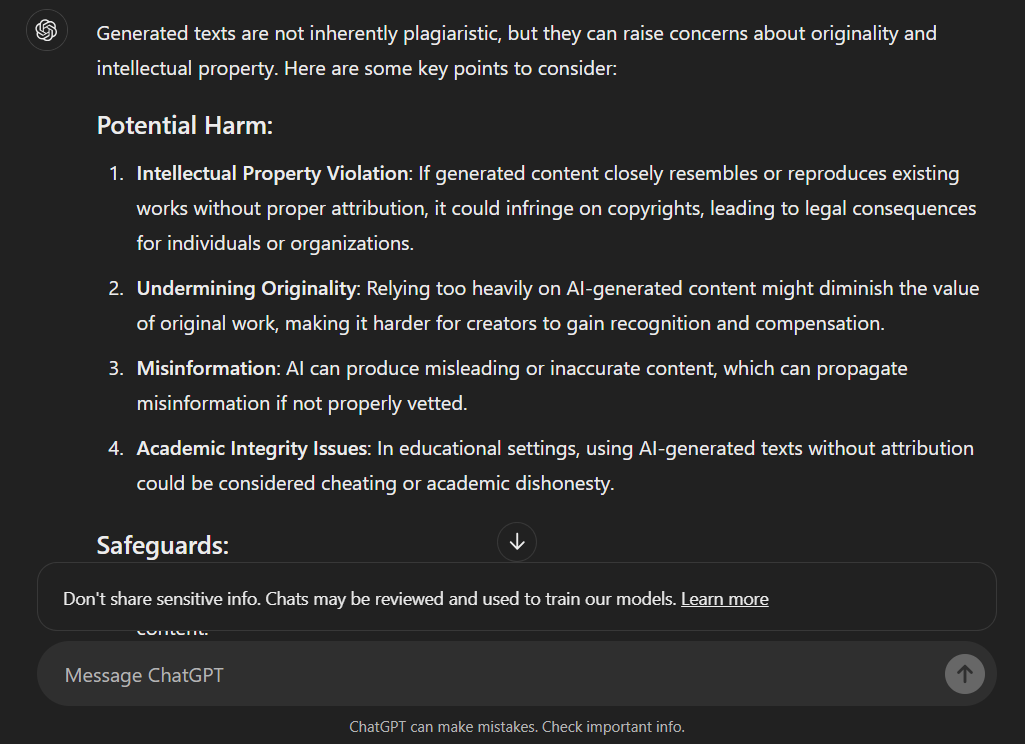
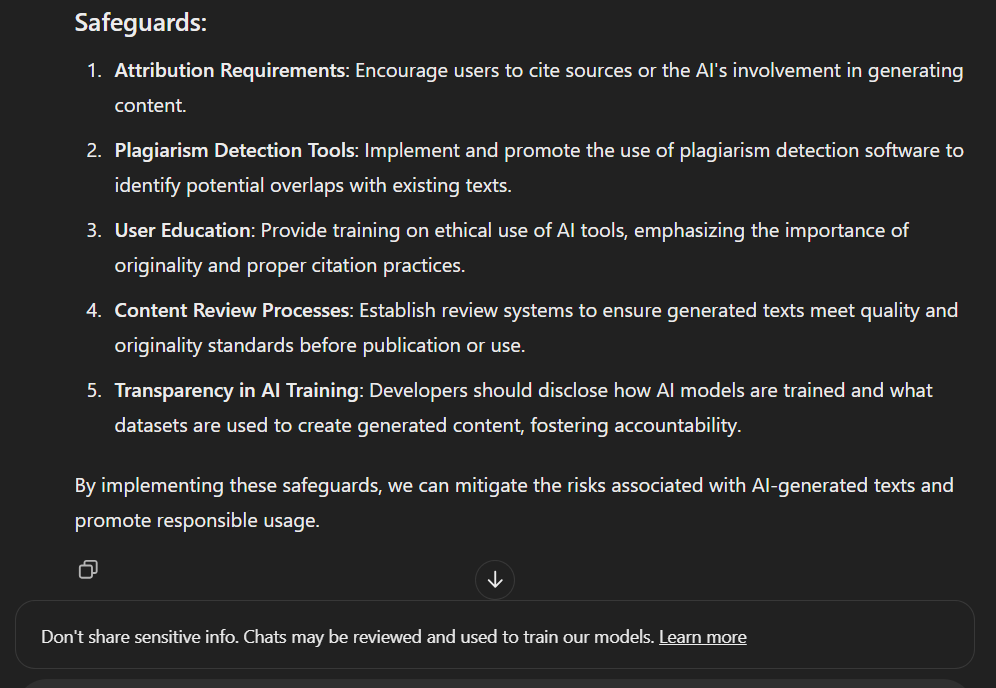
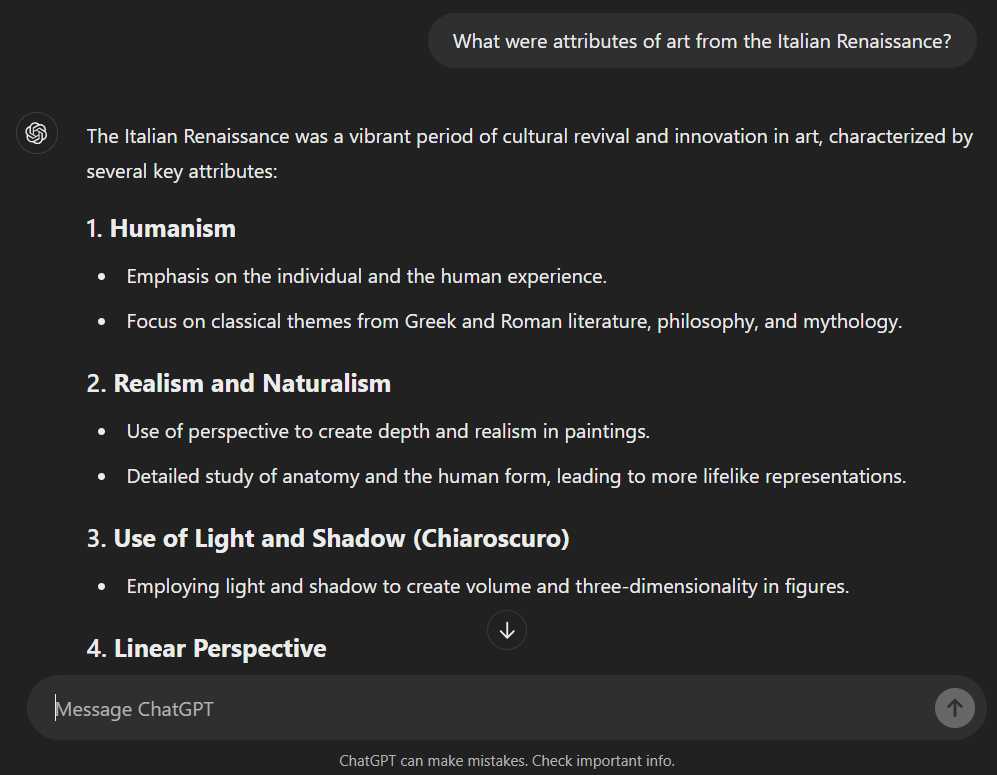
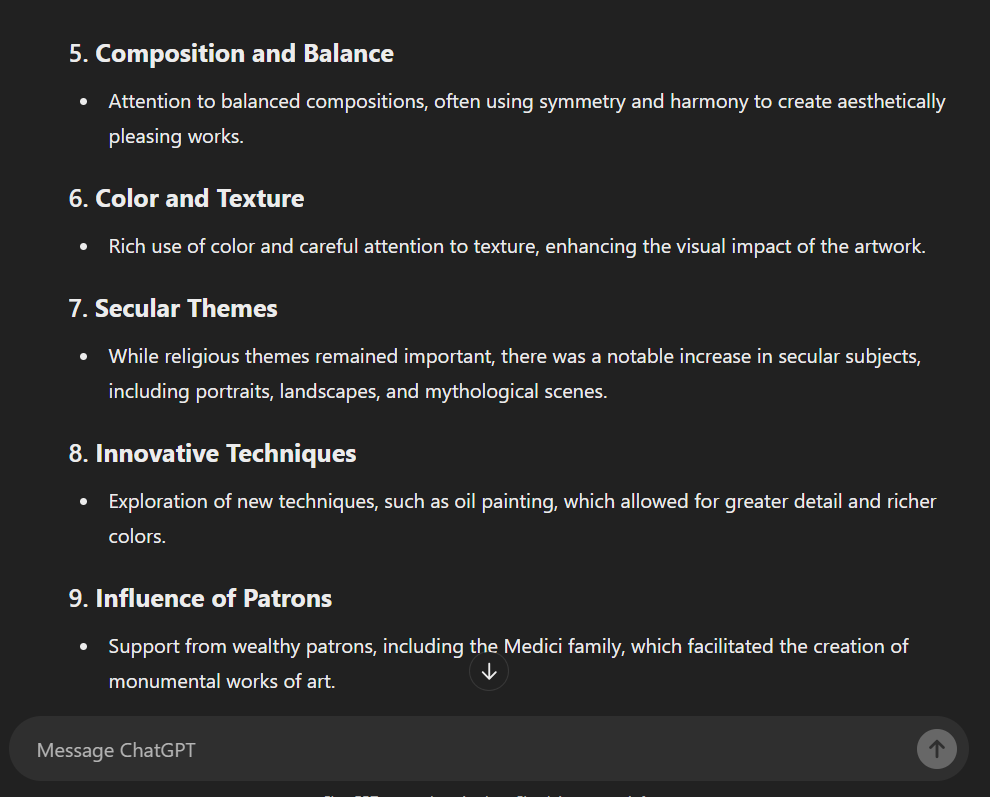
When asking ChatGPT if generated texts are inherently plagiaristic, it stated, “Generated texts are not inherently plagiaristic, but they can raise concerns about originality and intellectual property.” The rest of its output can also be seen above. However, I disagree that ChatGPT is not inherently plagiaristic. When going through out my educational careers I have always been taught to credit information in the form of in-text or bibliographical citations in formats such as APA, MLA, or Chicago. I wanted to see how ChatGPT would respond to being asked a question that is not common knowledge which does not fall under plagiarism guidelines. I also wanted to see its reply when asked to provide sources for all the information it gave in its response to my question. To test this, I input the question: “What were attributes of art from the Italian Renaissance?” This question is not common knowledge and does provide basic research to answer. It responded with many common stylistic techniques that can be found commonly among art during the Italian Renaissance period. I then asked, “can you give me a list of your sources?” ChatGPT’s response can be seen in the screenshot displayed below.
I then asked, “can you give me a list of your sources?” ChatGPT’s response can be seen in the screenshot displayed below.
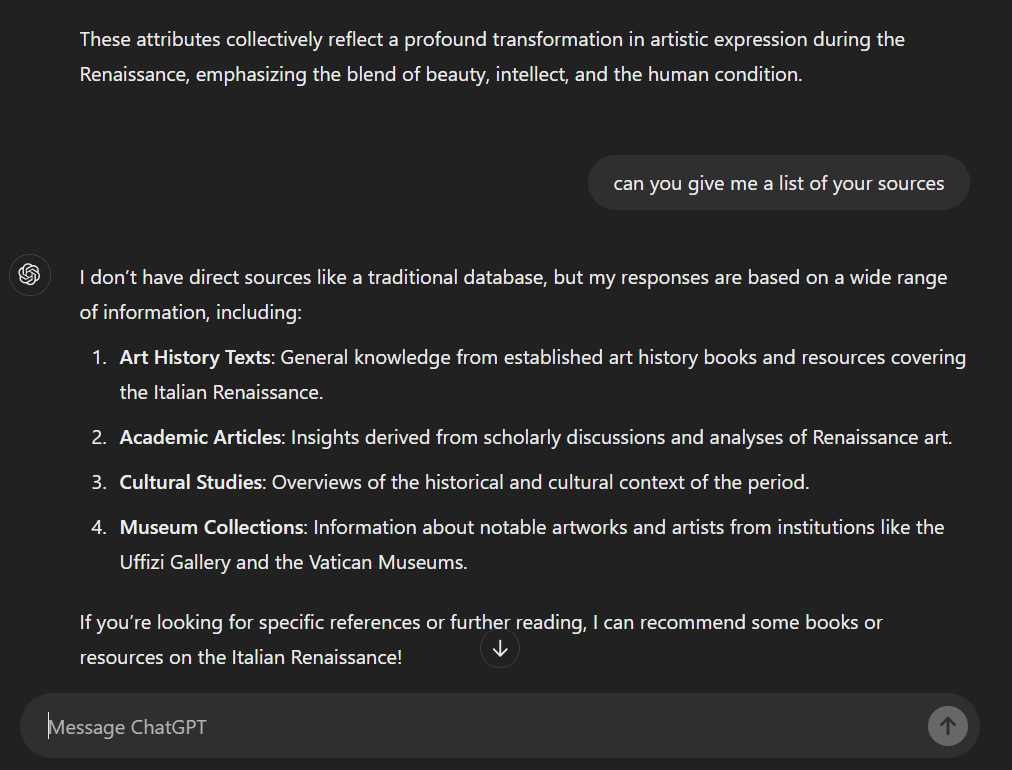
The sources that ChatGPT used to acquire its outputs all require citations to give proper credit to the authors or curators who put in the arduous work to create their individual conclusions. This makes ChatGPT extremely problematic when considering the ethics of how it spreads information. ChatGPT takes from many sources and compiles them into a generic summary without crediting those who researched and documented their findings. Every area of study has a code of ethics when conducting research in a certain topic. This is to ensure that all researchers are collecting and using information fairly. There is no code of ethics for ChatGPT, meaning there is nothing holding the application accountable when it plagiarizes sources. This also makes the ChatGPT user responsible for understanding where the various outputs are coming from. This is problematic as it can allow for misinformation to spread from lack of education of the sources used to create the output of information. This allows ChatGPT to convey information as its own while taking from many sources and failing to cite them. To further prove my point, I asked ChatGPT, “what is plagiarism.” ChatGPT’s response can be seen below.
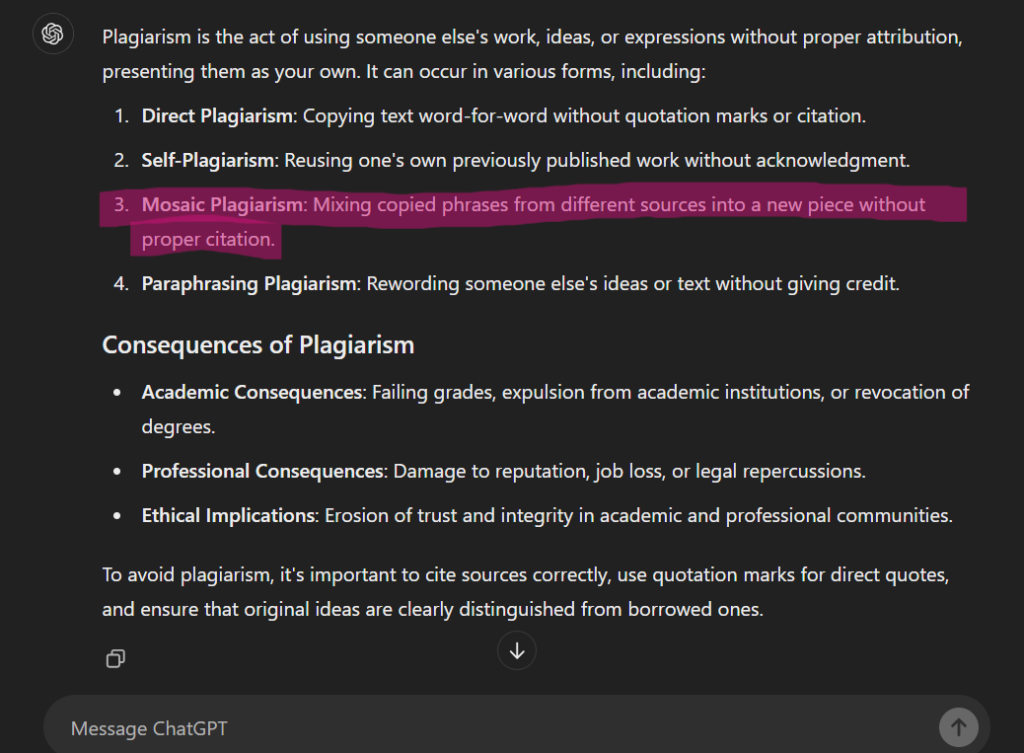
As hypocritical as it is, the third point in ChatGPT’s answer is exactly what the application is doing when spreading information to its users. In conclusion, ChatGPT can be a helpful tool to assist in the beginning processes of research such as creating a question to research, however it should not be used to create or inform research.