
The Ethics of ChatGPT

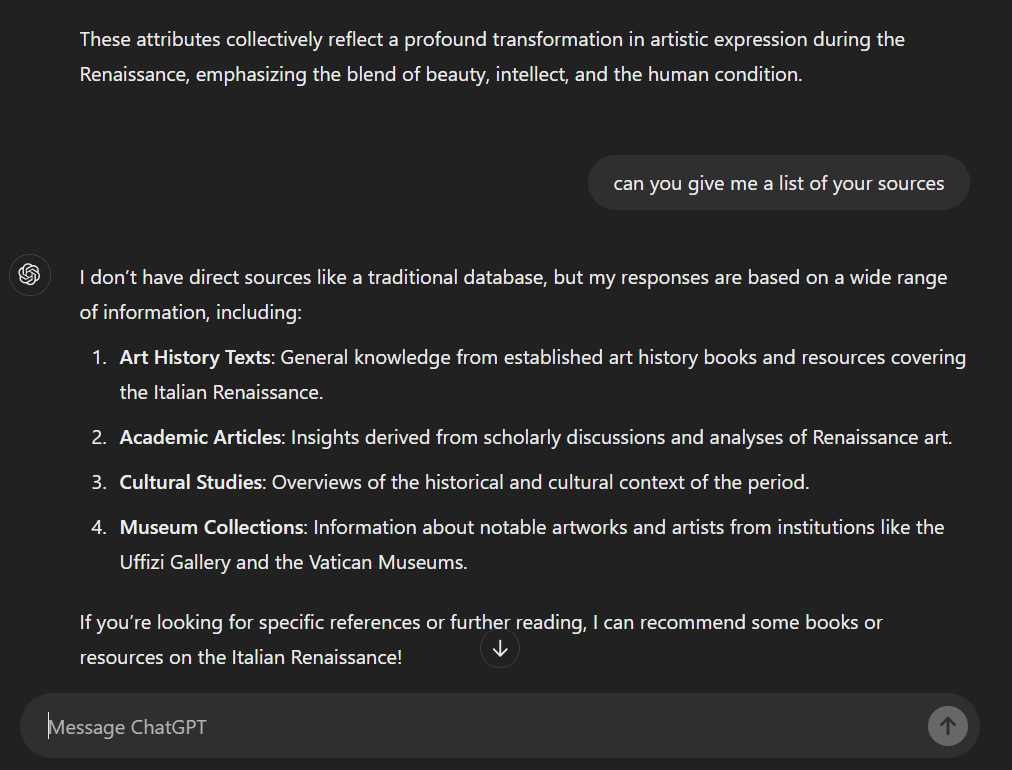
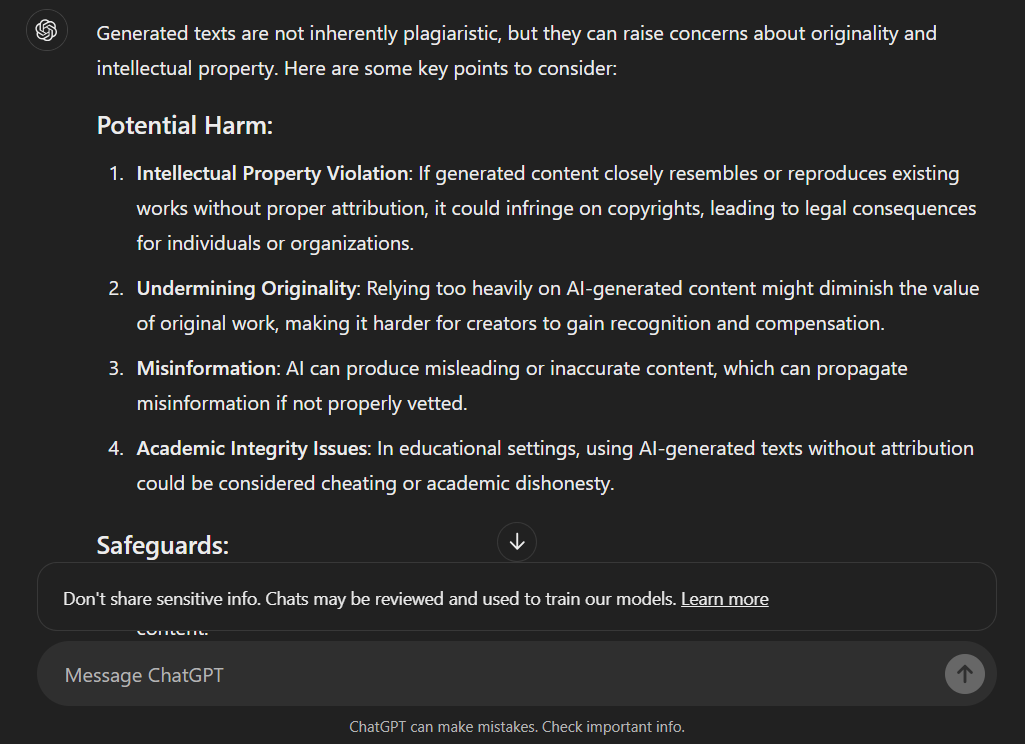
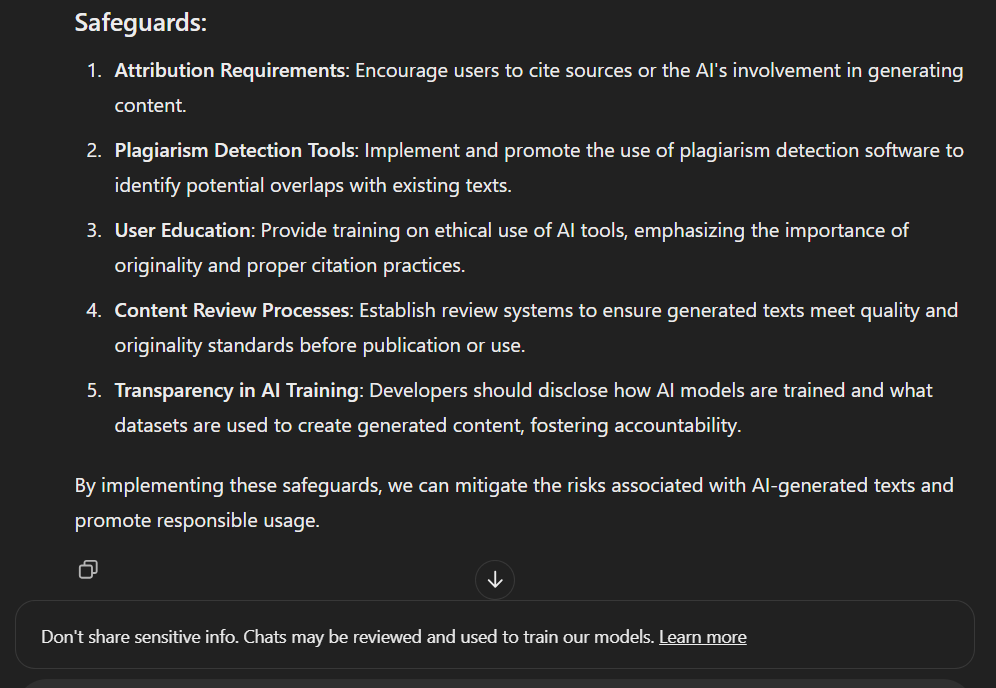
When asking ChatGPT if generated texts are inherently plagiaristic, it stated, “Generated texts are not inherently plagiaristic, but they can raise concerns about originality and intellectual property.” The rest of its output can also be seen above. However, I disagree that ChatGPT is not inherently plagiaristic. When going through out my educational careers I have always been taught to credit information in the form of in-text or bibliographical citations in formats such as APA, MLA, or Chicago. I wanted to see how ChatGPT would respond to being asked a question that is not common knowledge which does not fall under plagiarism guidelines. I also wanted to see its reply when asked to provide sources for all the information it gave in its response to my question. To test this, I input the question: “What were attributes of art from the Italian Renaissance?” This question is not common knowledge and does provide basic research to answer. It responded with many common stylistic techniques that can be found commonly among art during the Italian Renaissance period. I then asked, “can you give me a list of your sources?” ChatGPT’s response can be seen in the screenshot displayed below.  
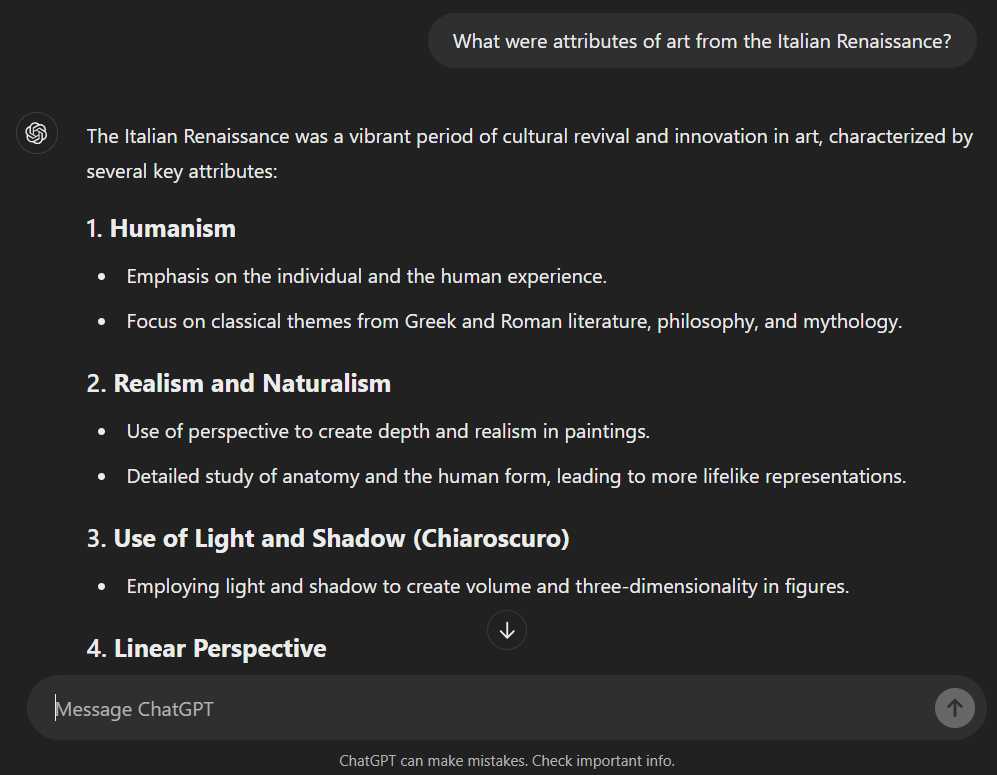
 I then asked, “can you give me a list of your sources?” ChatGPT’s response can be seen in the screenshot displayed below.    
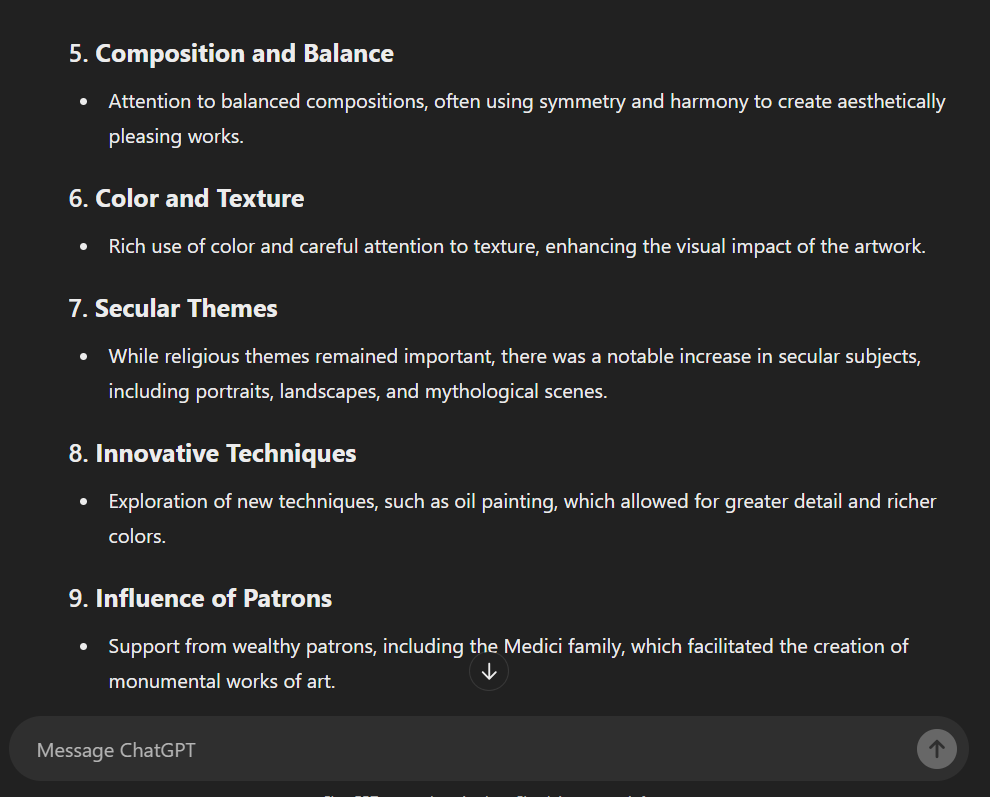
The sources that ChatGPT used to acquire its outputs all require citations to give proper credit to the authors or curators who put in the arduous work to create their individual conclusions. This makes ChatGPT extremely problematic when considering the ethics of how it spreads information. ChatGPT takes from many sources and compiles them into a generic summary without crediting those who researched and documented their findings. Every area of study has a code of ethics when conducting research in a certain topic. This is to ensure that all researchers are collecting and using information fairly. There is no code of ethics for ChatGPT, meaning there is nothing holding the application accountable when it plagiarizes sources. This also makes the ChatGPT user responsible for understanding where the various outputs are coming from. This is problematic as it can allow for misinformation to spread from lack of education of the sources used to create the output of information. This allows ChatGPT to convey information as its own while taking from many sources and failing to cite them. To further prove my point, I asked ChatGPT, “what is plagiarism.” ChatGPT’s response can be seen below. 
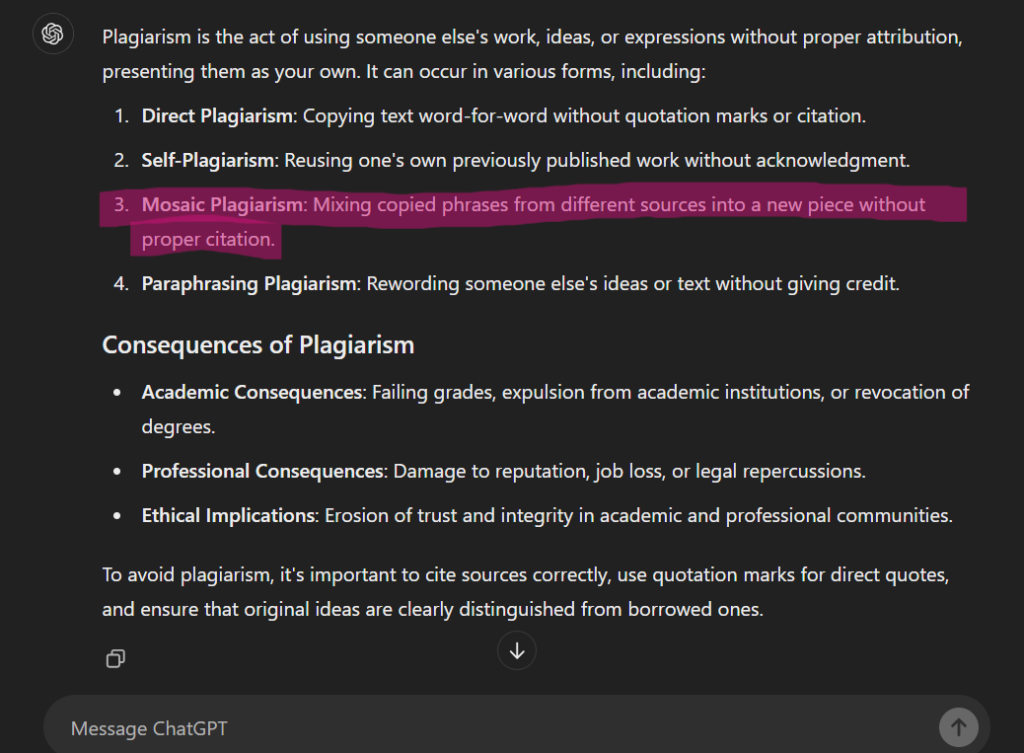
As hypocritical as it is, the third point in ChatGPT’s answer is exactly what the application is doing when spreading information to its users. In conclusion, ChatGPT can be a helpful tool to assist in the beginning processes of research such as creating a question to research, however it should not be used to create or inform research. 
Brainstorming Website Images

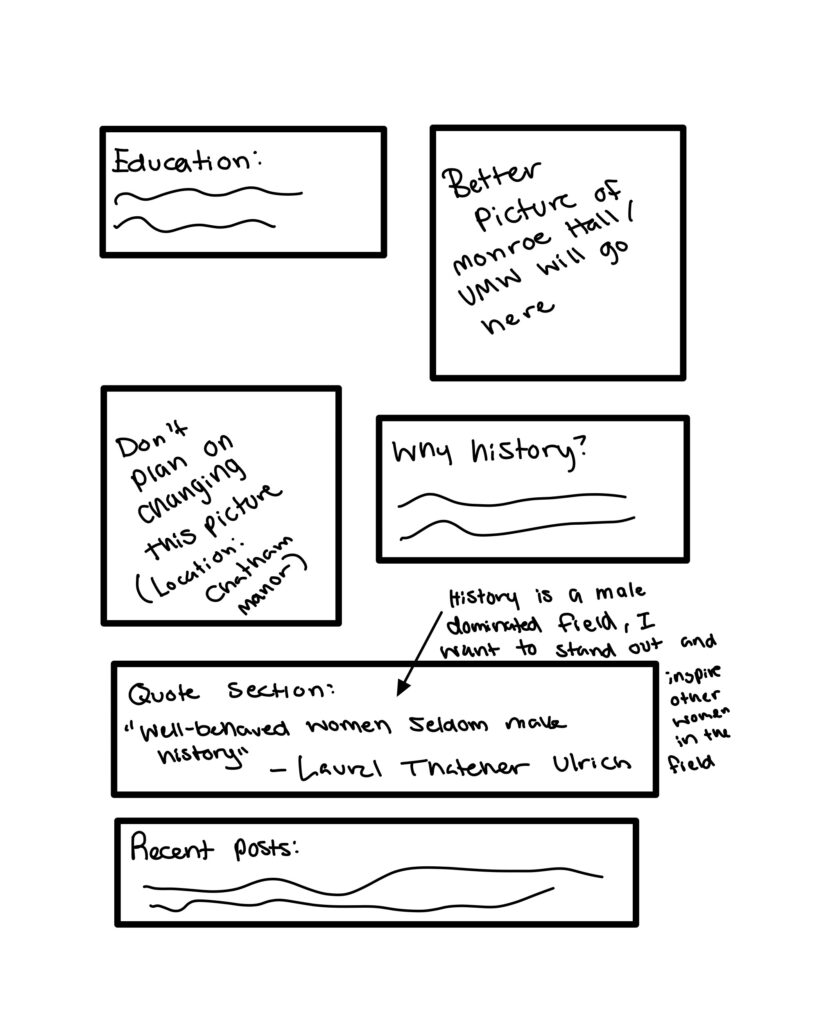
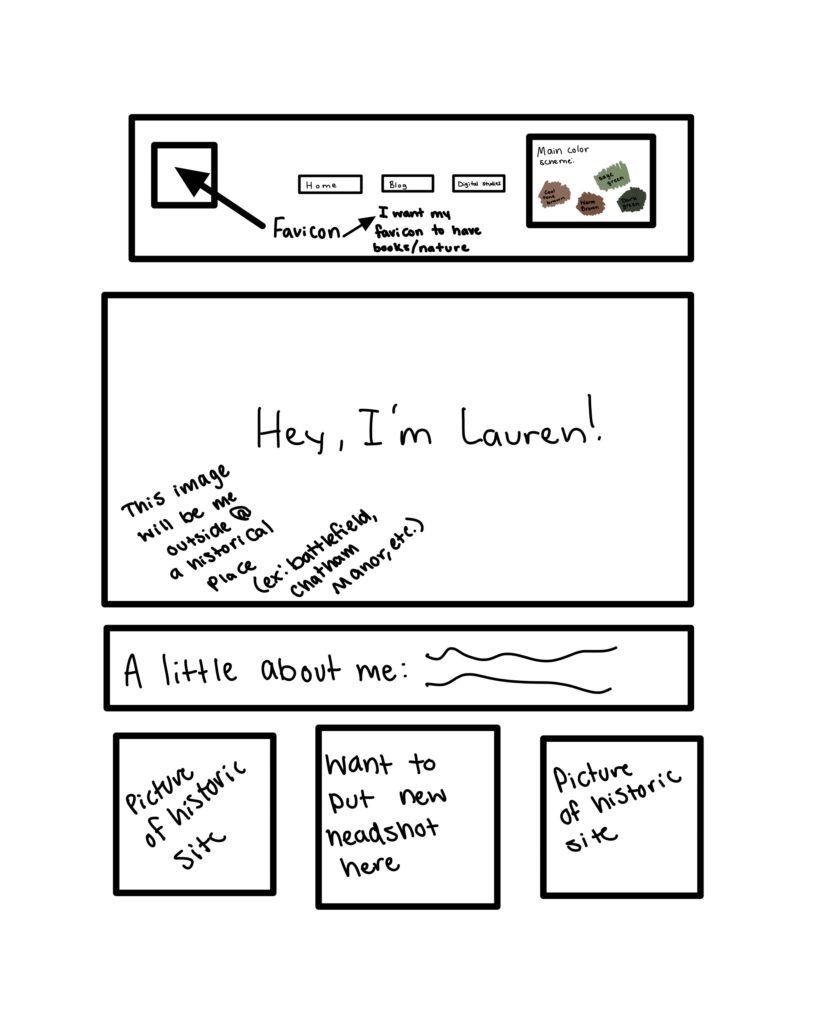
There are three main images that I want to create for my website, a headshot, a favicon or website logo, and a few different photos featuring historical sites to fill in the gaps on my home page. The color scheme I hope to achieve for these photos is in the top right corner of the first image shown on the left. These colors include dark and light browns which I think will give my page a professional feel while not making it completely lifeless. The reason why I went with these two specific colors is that I think they embody the study of history very well. When I think of brown it often brings the thought of books or a library to mind, which are both obviously very important when studying history. When I think of green, I immediately think of the outdoors, which is another important aspect of the study of history because there are many historical places to visit that require you to be outside to enjoy. I think it will be very easy to achieve this color scheme as the photos of different historical places and the new photo of Monroe Hall will be taken outside.  

I would also like to implement these colors into my headshots. I plan on taking two different groups of headshots, some outside and some in a photo studio. For the headshots I photograph outside, it will be very easy to achieve the natural aesthetic that I want to create due to there being plenty of foliage surrounding the University of Mary Washington’s campus right now. For the group of headshots that I want to photograph in a studio, I plan to choose a light green back drop to keep with the color scheme while also not making the picture look too dark by using a color such as brown. To execute these photos, I plan on renting a camera from the Hurley Convergence Center and utilizing the filming studio in the basement to take the indoor headshots. I also plan to talk to the Digital Knowledge Center on learning how to photoshop to make my photos look more refined. 

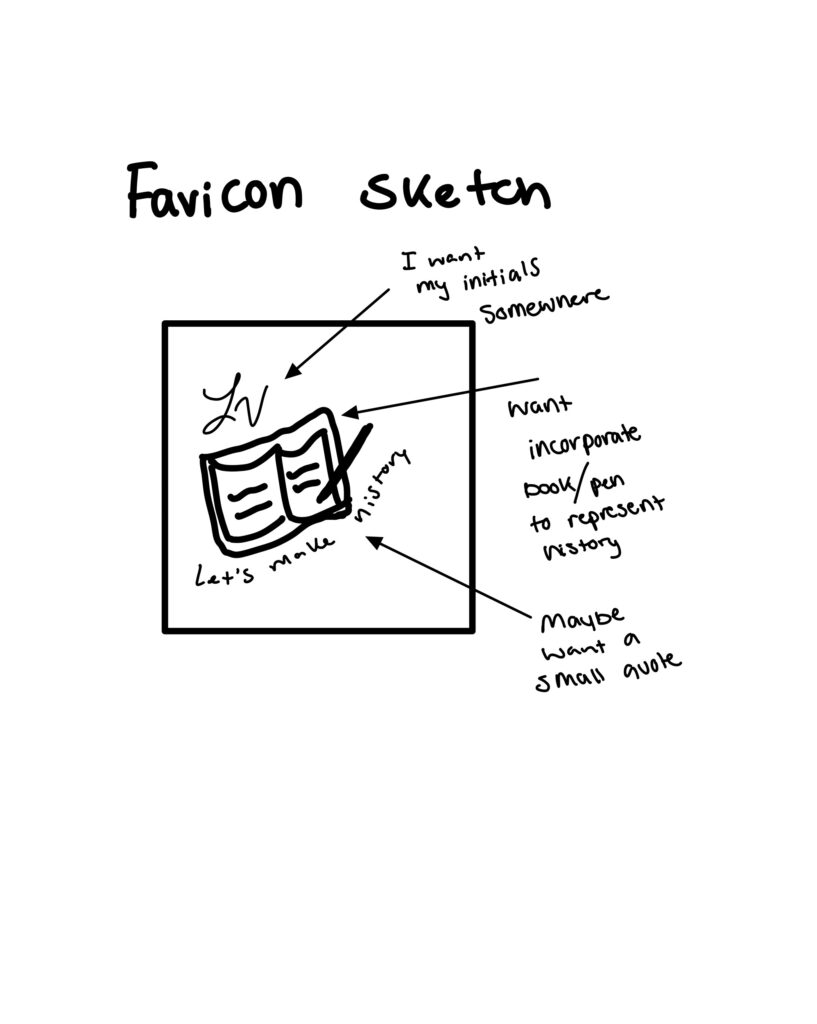
Finally, I plan to create my favicon which will be created fully online. The tool that I have the most experience with and I find the easiest to work with is Canva. Canva is an easy application which allows you to create digital images for many different projects, such as website logos or banners. The brainstorming sketch of my new favicon can be seen on the right in the photo gallery displayed. I have already created a favicon however; I have run into some issues with the one I have already created. The first issue was that you could not see the quote or the flower that was on it, to get rid of this issue on my new favicon I plan on just putting and enlarged outline image of a book and a pen. I believe both represent the study of history well and will be able to be seen better on the corner of an open tab. The second issue I ran into was that you cannot clearly read my name on the favicon, to fix this I plan on using just my initials as that will make it so I can make the font on the letters larger while still adding a personal touch to the favicon. My final issue with my original favicon is that the quote, “Let’s Make History” cannot be seen. Due to this I have decided to simply get rid of the quote so my website visitors can focus more on the image of the book and pen. Overall, after my first attempt at a favicon, I understand now that it cannot be overly detailed. 

Hello and Welcome!

My name is Lauren, and I am a junior at the University of Mary Washington where I am working to receive my bachelor’s degree in history. I enjoy doing anything and everything outdoors, including kayaking, fishing, and exploring local historical sites. History has always excited me, and through living locally to various historic sites in King George, Fredericksburg, and Spotsylvania I have been forcibly immersed in specifically colonial American history. This immersion led to me being very passionate in the research and study of American history. Although many of the sources I study are print, it is extremely important for me to adapt to how source material and information have become much more digitized. The main goal of my website is to display my professional historic research and projects digitally. It is easy to assume that due to me growing up in a digital revolution I would be well versed in anything and everything technology, this could not be further from the truth. After Covid I fell out of interest in the technological world, as frankly I got tired of seeing it in every aspect of my daily life. I hope to grow to love the internet again and effectively portray myself to future employers and history buffs alike through this website. I hope you enjoy!